



Burnout has become so normalized in the United States that we talk about it like weather — an unfortunate inevitability we’re expected to push through, joke about, or treat with a scented candle and a weekend off. But what we call burnout today is not a neutral condition of “modern life.” It’s a predictable harm produced by capitalism, colonialism, and the psychological machinery that keeps both systems running.
Everywhere I go — in arts institutions, in newsrooms, in academia, in organizing spaces — people whisper the same thing: I’m exhausted. Not tired. Not worn out. Exhausted in that bone-deep way that makes you forget who you are. I know that version of burnout. It took me two years to recover from the last time it swallowed me whole. Even now, I can feel the familiar creep of it tugging at the edges of my body: the sleeplessness, the brain fog, the emotional flatline that comes from carrying more than human beings should have to.
But burnout is not simply “too much work.” It is a psychological consequence of surviving systems built on the extraction — of labor, of culture, of identity, of our emotional bandwidth. And if we’re going to name it honestly, we need to recognize how much of burnout is shaped by the Colonial Psychological Complex (CPC) and its branches, including Colonial Stockholm Syndrome (CSS), Colonial Social Conditioning (COSOC), Oppressive Cognition, and the narrative manipulation that keeps us believing we should endure the very systems draining us.
Burnout as a Colonial Relic
Capitalism didn’t invent burnout; colonialism did. The extraction of human capacity — the belief that people exist to be used, optimized, disciplined, and controlled — is a colonial inheritance. Capitalism simply industrialized it.
In the CPC framework, we understand that colonial ideologies don’t vanish; they mutate. They migrate from plantation fields to corporate cubicles, from forced conversion to workplace “culture,” from overt domination to the soft-pedaled violence of “productivity expectations.”
Under CSS, people internalize loyalty to the very systems harming them because those systems convince us that our worth is tied to compliance:
Work harder.
Prove yourself.
Don’t be difficult.
Never rest.
Never inconvenience the institution.
Burnout isn’t a glitch. It’s the psychological outcome of a machine that requires our depletion to sustain itself.

Oppressive Cognition and the Emotional Capture of Work
Oppressive Cognition explains how people forced to navigate overlapping systems of oppression develop survival mentalities that center fear, urgency, and self-monitoring. In a society where your job is tied to your healthcare, your rent, your ability to feed your children, or the thin thread holding your identity together, rest becomes dangerous.
So we abandon ourselves.
We run on fumes.
We ignore the warning signs.
Burnout is what happens when our survival instincts are manipulated into obedience.
Capitalism tells you that exhaustion is a personal responsibility. Colonial logic tells you it’s a moral failure. Together, they produce an emotional environment where burnout becomes individualized rather than recognized as systemic abuse.
The D.R.I.P. Cycle and the Propaganda of “Self-Care”
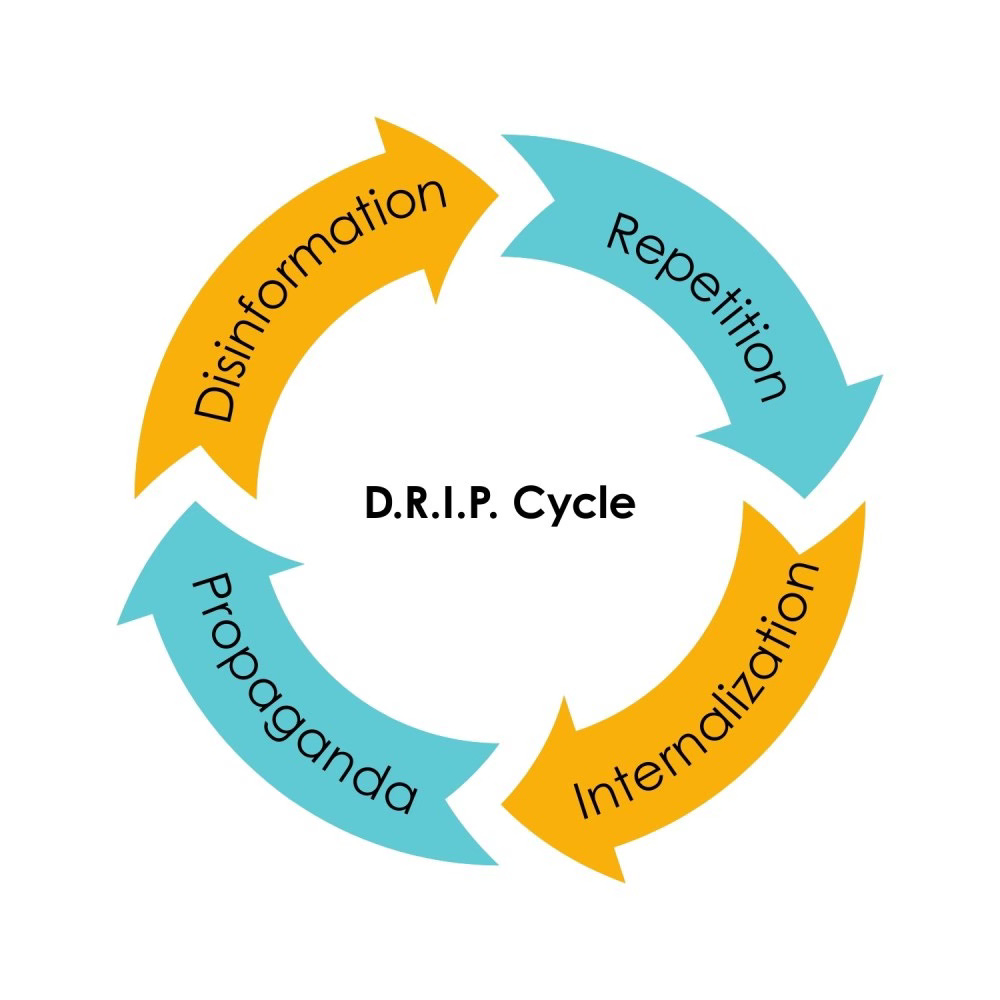
The D.R.I.P. Cycle (Disinformation → Repetition → Internalization → Propaganda) shows how harmful ideas evolve into unquestioned cultural norms.
Take the corporate version of “self-care.”
Disinformation: If you just managed your time better, you wouldn’t be burnt out.
Repetition: Productivity gurus, HR seminars, LinkedIn posts.
Internalization: This must be my fault.
Propaganda: A culture where we shame ourselves for needing rest.
Capitalism has commodified “wellness” into a privatized coping mechanism — not a systemic solution. And colonial narratives frame sacrifice as virtue, exhaustion as devotion, and silence as professionalism.
Self-care becomes another task, another expectation, another way to blame ourselves for symptoms created by the system itself.
Why Burnout Is Getting Worse
We are living at the intersection of economic collapse, political instability, cultural fragmentation, and personal grief. The world is burning — literally — and capitalism demands that we clock in on time.
At the same moment:
Wages are stagnating.
Rents are skyrocketing.
Healthcare is still a luxury.
AI threatens livelihoods.
News cycles never end.
Communities are fractured.
Violence is normalized.
Institutions are failing.
And capitalism’s response?
“Have you tried yoga?”
Meanwhile, the colonial logic beneath these crises intensifies. Communities of color, immigrants, disabled people, queer folks — we carry the additional weight of historical dispossession and generational trauma. Burnout hits us faster and deeper because we are navigating extraction on multiple fronts: racial, cultural, political, economic and emotional.
When the Body Says No — and the System Says Keep Going
I didn’t “recover” from burnout. I rebuilt myself around what it taught me: that I had been conditioned to sacrifice my body to systems that would not resurrect me.
Now, when I feel burnout approaching, I don’t “make time” for rest — I force it. Because I remember what it felt like when my nervous system collapsed under the weight of pretending I was fine. When the panic attacks weren’t metaphorical. When the world shrank to a tunnel of survival mode I couldn’t escape.
Burnout is not failure. It is the body’s rebellion — a refusal to participate in its own exploitation.
Toward a Decolonial Approach to Rest and Work
A decolonial approach to burnout requires more than bubble baths and PTO. It requires rejecting the entire narrative architecture that tells us our worth is tied to production.
Decolonizing burnout means:
Reclaiming our right to rest without guilt.
Naming exhaustion as evidence of structural harm.
Understanding our bodies as archives of colonial history.
Interrupting the psychological conditioning that binds us to harmful institutions.
Rebuilding community-centered ways of working and healing.
Refusing narratives that celebrate scarcity, urgency, and martyrdom.
Practicing boundaries as acts of resistance.
And most importantly: letting ourselves be human in systems that treat humanity as expendable.
The Truth We’re Not Supposed to Say Out Loud
Burnout is getting worse because capitalism has reached a point where it can no longer hide its colonial roots. The façade of opportunity is fading. The myth of meritocracy is collapsing. People are waking up to the reality that the system was never designed for our well-being — only our utility.
When we burn out, we are not breaking down.
We are breaking free.
Our bodies stop performing loyalty to systems that refuse to love us back.
And that, in its own way, is the beginning of decolonization.
The Colonial Condition is a publication dedicated to critically interrogating colonial legacies, decolonial resistance, and historical reckonings. We challenge dominant narratives and amplify marginalized perspectives. Join the conversation — read, question, and disrupt.