


May 7, 2025
On May 4th, the official White House account posted a bizarre tweet. It featured Donald Trump in a hyper-muscular Anakin Skywalker cosplay, gripping a red lightsaber with a vengeance, flanked by bald eagles and American flags. The accompanying caption labeled “Radical Left Lunatics” as the Empire—but here’s the problem: the man in the image is quite literally holding a red lightsaber while dressed like a Sith.
Let’s be clear: red is the symbolic color of the Sith. It’s not just a political alignment here—it’s a narrative alignment. The red saber has never stood for peace, compassion, or democracy. It’s the signature of tyranny, authoritarianism, and rage. And for all the self-declared patriots out there who think this image makes a strong statement, I offer this: if you’re carrying a red saber and flexing in a sleeveless Anakin tunic, you’re not the Rebellion—you’re the Empire.
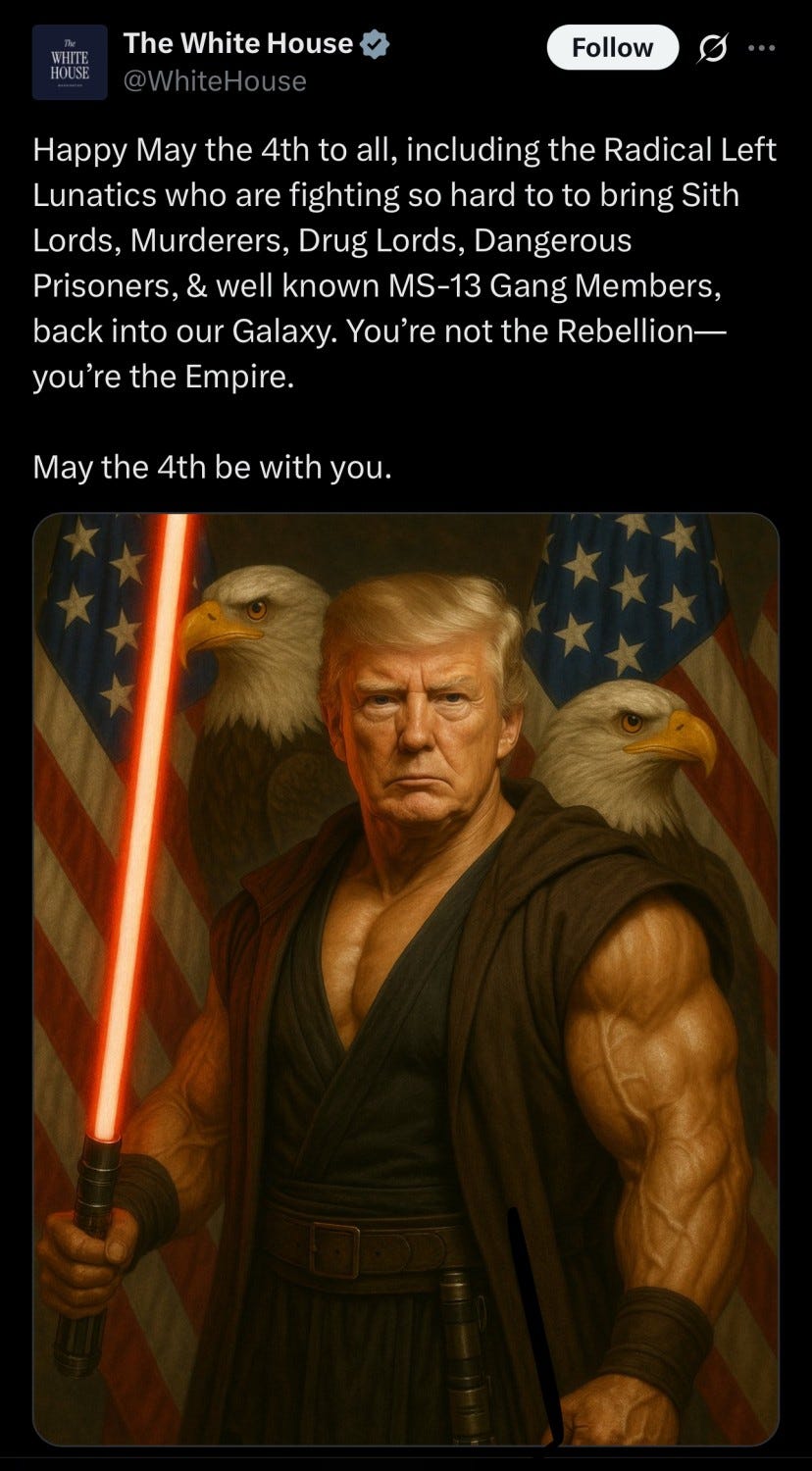
Visual Propaganda… But Make It Basic
This isn’t even good propaganda. It’s propaganda for dummies. It doesn’t try to be clever or subliminal—it yells its symbolism in all caps with zero nuance. That’s not strategy. That’s laziness dressed up as strength.
This is what happens when propaganda is simplified for an audience the administration assumes is uneducated. There’s no subtlety, no coded messaging. Just overt, heavy-handed symbology drawn from the most recognizable (and wildly misinterpreted) pop culture of our time. The Star Wars universe isn’t just a sci-fi playground—it’s a moral tale. And Trump, intentionally or not, keeps casting himself in the role of the villain.
Color Theory Matters
Yes, red is the Republican color. But in art and design, red also represents blood, aggression, danger, and domination. The lightsaber could’ve easily been purple—a nod to Master Windu, a complex character who balanced strength with wisdom and whose saber signified a mastery of both the light and dark sides of the Force. But Trump’s team doesn’t seem interested in complexity. They’re interested in brute force imagery. In the kind of “strength” that only exists in comic books and AI renderings.
Speaking of AI…
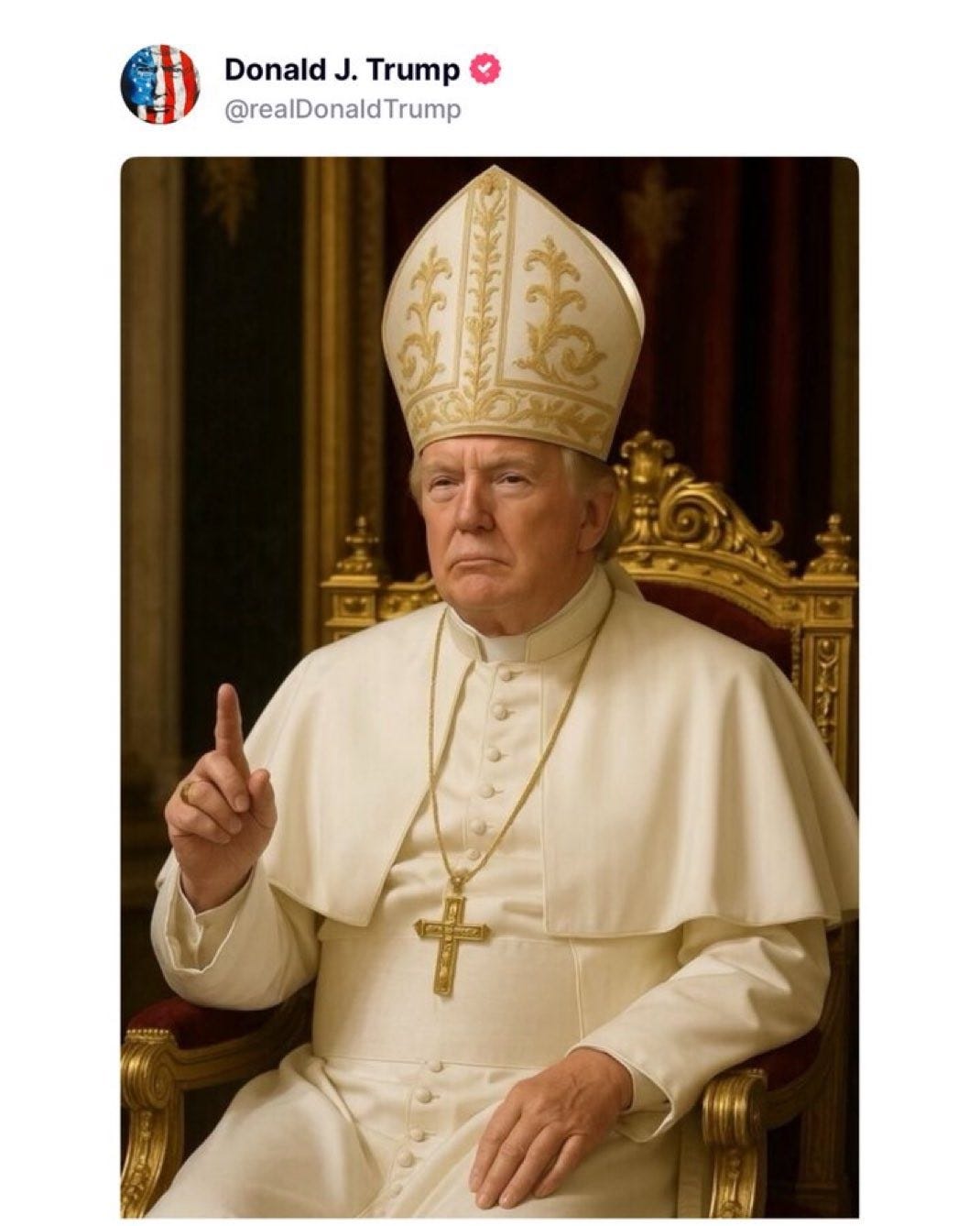
Let’s not forget the other bizarre AI-generated image released earlier this year: Trump as the Pope. Cloaked in white, photoshopped into spiritual sainthood, wrapped in religious sanctimony despite an unrepentant legacy of harm.
These images aren’t accidental. They’re part of a growing visual campaign of heroic iconography—a tradition that autocrats have used for centuries. But in this case, it’s being filtered through AI apps and meme culture. It’s glossy. It’s fantastical. And it’s riddled with lies. It’s also deeply ironic, given that the same administration is actively gutting public arts funding and attacking academic freedom—the very pillars of a visually literate society.
Why the Obsession with AI Makeovers?
Let’s ask the real questions here:
Why is this administration so obsessed with AI-generated imagery that transforms Trump into a physically idealized superhero?
Why are these images borrowing from religious and cinematic iconography to manipulate public emotion?
Why is there such an aggressive campaign to merge authoritarian branding with sci-fi aesthetics?
And why are the people most seduced by these visuals often the ones who rail against “fake news” while reposting literal fantasy?
The answer is layered, but here’s the core of it: when a regime doesn’t respect intelligence, it leans on spectacle. Visual culture becomes a weapon, and the goal isn’t to inform—it’s to inflame. To mesmerize. To distract. And to overwrite memory through repetition.
What To Watch For
This isn’t the last of it. Expect more AI-generated images. Expect more red sabers. Expect more cosplay disguised as cultural warfare. The question is whether the public can read the signs—or whether they’ll be too dazzled by lightsabers and delusions to recognize what’s happening.
This is why visual literacy matters. This is why the arts matter. This is why propaganda disguised as memes and merch must be interrogated—because the line between cosplay and cult of personality is razor thin.
So the next time you see an AI Jesus-Trump or Darth MAGA, ask yourself:
What story are they telling, and why are they so desperate for us to believe it?

Denise Zubizarreta is a Ph.D. student in Applied Social Justice at Dominican University, with an M.A. in Arts Leadership and Cultural Management from Colorado State University and a B.F.A. in Fine Art from Rocky Mountain College of Art + Design. She is the creator of the Colonial Stockholm Syndrome (CSS) framework, which she explores in her forthcoming book examining the psychological grip of colonialism on identity, belonging, and political behavior.
She serves as the Director of Development and Communications for the New Mexico Local News Fund and the Engagement and Development Director at Latina Media Co, where she advocates for equitable media ecosystems and the amplification of Latiné voices in journalism and cultural criticism.
As a scholar, cultural operations strategist, and interdisciplinary artist of Puerto Rican and Cuban descent, Denise focuses on colonization’s emotional and systemic legacies within diasporic and immigrant communities. Her research and artwork critically examine how disinformation is used as a tool of control, shaping public perception of immigrants, eroding trust, and reinforcing colonial narratives. Through her work, she bridges academic inquiry and lived experience to expose the roots and repercussions of propaganda in today’s polarized media landscape.