

The People’s House, Privatized
Trump, Authoritarian Architecture, and the Colonial Condition

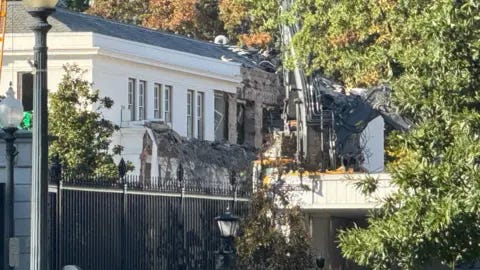
“From the south side of the building, the BBC saw several large pieces of construction equipment – some adorned with US flags – near the East Wing. Trump wrote in his post that the East Wing was ‘completely separate’ from the White House, though it is attached to the main structure. The covered entryway, which spans much of the East Wing’s south side, appeared as though it was being gutted, with concrete debris and metal cables clearly visible from several hundred metres away.” – BBC News, October 2025
The People’s House is being gutted.
Donald Trump’s demolition of the White House’s East Wing — to make room for a massive new private ballroom, funded by unnamed “patriots” — is more than another renovation. It is an act of symbolic conquest, a visible performance of dominion. The official narrative says the ballroom will be “the country’s finest,” a gift to the nation, “costing zero to the taxpayer.” But the deeper story is about the transformation of a public space into a private estate.
Authoritarians do this often. They remodel, rename, and reconstruct the architecture of governance to mirror themselves — to transform a seat of service into a monument of self. This is not new, nor is it subtle. The spectacle of “demolition” is itself the point: the sound of jackhammers reverberating through the East Wing announces that the White House no longer belongs to the people, but to the man who believes he alone embodies them.
The Colonial Logic of Demolition
In colonial psychology, the physical destruction of the old is always accompanied by the ideological construction of the new. The colonizer must not only conquer the land — they must overwrite its meaning. What once symbolized shared power becomes the stage for personal rule.
Trump’s ballroom project enacts what I call the Colonial Psychological Complex (CPC) — the entangled syndromes of Colonial Stockholm Syndrome (CSS), Colonial Savior Complex (CSC), Colonial Narcissism Syndrome (CNS), and Colonial Social Conditioning (COSOC). These frameworks describe how power is not only seized but psychologically normalized through repetition and spectacle.
In this case, CNS manifests most clearly: the narcissistic belief that one’s image must be immortalized through architecture. By reshaping the White House to reflect his own grandeur, Trump is performing what colonizers have done for centuries — repurposing public monuments into private mirrors. The message is clear: I am the state; the state is me.
But COSOC — Colonial Social Conditioning — is what makes this transformation sustainable. When Trump declares that the East Wing is “completely separate” from the White House, he is not just lying about architecture; he is reframing the narrative of ownership. Colonial conditioning requires consent through confusion — blurring the boundaries between public and private, authority and service, democracy and dominion.
When media outlets quote him without interrogation, when donors remain anonymous, when the public shrugs because “presidents renovate all the time,” this is CSS — Colonial Stockholm Syndrome — at work: the psychological identification with the abuser, the internalized belief that exploitation is somehow deserved, justified, or inevitable.
From Public Institution to Private Mansion
To understand the magnitude of this act, we must remember that the large-scale demolition of the White House is exceedingly rare. The last time the structure was gutted was during the Truman reconstruction of 1948–1952, when the interior was literally collapsing. Even then, the project was publicly funded, transparently executed, and motivated by safety — not ego.
Trump’s East Wing demolition, by contrast, is funded by “many generous Patriots” whose names remain undisclosed. In colonial history, this is called patronage: the exchange of capital for access, where the ruler’s proximity becomes the new currency.
Architecture is power rendered visible. The White House has long served as a symbol of American democracy — a shared national artifact representing both governance and the collective imagination of “the people.” To tear down a part of it for a ballroom — a site of opulence, exclusivity, and private celebration — is to invert that symbolism. It’s no longer the People’s House; it’s the palace of a patriarch.
This pattern echoes the 19th-century colonial governors who converted administrative buildings into grand residences, complete with banquet halls and European flourishes. The colonizer’s logic is always the same: if the land is mine to rule, its architecture must reflect my glory.
The Psychological Performance of Permanence
Trump’s actions reveal a deeper pathology of authoritarian psychology: the obsession with permanence. Colonizers and autocrats alike fear impermanence because it implies accountability. To demolish is to declare intention to remain — to leave a mark too expensive, too massive, too sacred to reverse.
In decolonial terms, this act represents Oppressive Cognition — the psychological state imposed on the collective when living within multiple systems of domination simultaneously. Americans are being conditioned to accept the privatization of democracy as natural. “It’s just a renovation,” they’re told. “He’s improving it.” But the collective mind under oppression learns to adapt to absurdity, to rationalize desecration as destiny.
The sight of heavy machinery adorned with American flags — “several large pieces of construction equipment… near the East Wing,” as the BBC described — is almost too on the nose. It’s patriotism weaponized as camouflage, nationalism used to justify the destruction of a national symbol. This is the visual language of empire: conquest wrapped in ceremony.
The Myth of Generosity
By framing the ballroom as a “gift,” Trump invokes Colonial Savior Complex (CSC) — the belief that his domination is benevolent. Colonial powers have long justified exploitation through the language of generosity: “We built the roads,” “We brought civilization,” “We improved the infrastructure.”
Similarly, Trump’s rhetoric — that this opulent ballroom will “cost nothing to the taxpayer” — reframes private gain as public service. Yet without transparency, these so-called “patriots” may just be buying influence, laundering power through philanthropy. Colonialism has always thrived on this exchange: patronage masked as patriotism.
The Architecture of the Colonial Mind
Every authoritarian regime understands architecture as propaganda. Buildings speak — and what they say depends on who controls the narrative. By demolishing the East Wing, Trump is rewriting the architectural story of American democracy in his own language.
Where the White House once symbolized the temporality of power — presidents come and go — it now projects the permanence of the man. The ballroom, like the gilded towers that bear his name, is both shrine and stage: a site for worshipping wealth, spectacle, and self.
In the Colonial Condition, this is how empire reproduces itself — not through explicit conquest, but through the domestication of symbols. Colonialism, after all, never ended; it merely changed its address.
The Psychological Aftermath
The true violence of colonial acts is not physical destruction but psychic colonization. When people begin to accept that a president can tear down and rebuild the People’s House to his taste, when they call it “tradition” or “legacy,” the colonial condition is complete. The mind has been occupied.
Oppressive Cognition thrives in such environments: when the governed internalize the governor’s logic, when the colonized begin to protect the colonizer’s myth. Trump’s demolition is not just architectural — it’s epistemic. It reshapes what Americans believe democracy looks like.
And like all colonial projects, it begins with erasure.
The House That Power Built
Trump’s new ballroom is not a renovation; it is a revelation. It exposes how colonial logic operates in modern politics — how the authoritarian impulse mirrors the imperial one. Both claim to build while they destroy, to give while they take, to preserve while they erase.
The White House once symbolized a republic in motion, a space belonging to the collective. Now, under the pretense of patriotism, its very foundations are being rewritten in the language of ownership.
Colonialism, in all its forms, begins when someone looks at what is shared and says, This is mine.
The Colonial Condition is a publication dedicated to critically interrogating colonial legacies, decolonial resistance, and historical reckonings. We challenge dominant narratives and amplify marginalized perspectives. Join the conversation — read, question, and disrupt.