

The Revolution Was Televised
Kendrick Lamar’s Super Bowl Halftime Show as Radical Art

February 10, 2025
A Super Bowl Performance Unlike Any Other
Kendrick Lamar’s Super Bowl LIX halftime show wasn’t just a performance—it was a masterclass in radical art, historical reckoning, and cultural defiance. It was a moment that transcended entertainment, turning the biggest corporate spectacle in America into a battlefield of truth, layered with symbolism, resistance, and the weight of Black history.
As an arts researcher, cultural strategist, and scholar, I could write about this performance for years. And trust me, I will. But for now, we need to talk about why this halftime show mattered immediately and what made it one of the most significant acts of live performance art in recent memory.
Kendrick’s Opening Line: A Thesis Statement in One Sentence
Lamar wasted no time setting the tone. As the lights hit, his words echoed across the stadium:
“The revolution ‘bout to be televised. You picked the right time but the wrong guy.”
This was a direct subversion of Gil Scott-Heron’s famous phrase, “The revolution will not be televised,” which critiqued the idea that true systemic change could be broadcast as entertainment. Lamar’s modification of the phrase suggested that this moment—his performance—was a revolutionary act in itself.
By stating, “You picked the right time but the wrong guy,” Lamar made it clear that he would not be used as a pawn for corporate, sanitized representation. The Super Bowl, an event designed to be an apolitical celebration of American consumerism, had selected him to entertain—yet they might have unknowingly (we won’t really know the BTS of this for a while) placed one of the most politically charged artists on the biggest stage. This line was Lamar’s way of signaling to the audience that his performance would not conform to expectations.
In this sense, Lamar was both embracing and rejecting the stage he had been given. He acknowledged the enormity of the moment but refused to be confined by it, turning the halftime show into a space of unfiltered Black expression rather than just an entertainment spectacle.
The American Flag on Black Bodies: A Symbol of Burden and Ownership
One of the most visually striking moments of Lamar’s performance was the formation of the American flag by the dancers. Rather than displaying an actual flag, the imagery was created using the bodies of performers dressed entirely in red, white, and blue. This wasn’t just a creative staging choice—it was a statement about America itself.
By constructing the flag through the dancers’ bodies, Lamar reinforced the historical reality that Black people have literally carried this country on their backs. The United States, from its economic foundations built on slavery to its cultural dominance shaped by Black artistry, has long benefited from Black labor, talent, and resilience—while simultaneously denying full recognition, rights, and equity. The weight of this flag, formed through movement, reflected the ongoing burden placed on Black Americans to uphold a nation that has historically oppressed them.
Additionally, this image subverted traditional patriotic iconography. The American flag is often displayed as a symbol of unity and pride, yet here, it was unstable, shifting, and fragmented—a reminder that the ideals America claims to uphold are not experienced equally by all its citizens. This living, breathing flag suggested that the nation is still in flux, still grappling with its own contradictions, still asking the question: Who gets to claim America? And at what cost?
This was not a celebration—it was an indictment. A reminder that Black people are the foundation of this country, yet their labor and contributions remain unacknowledged, co-opted, or erased. By placing the flag on the backs of Black bodies, Lamar’s performance exposed a truth that America continues to ignore: This country would not exist without them—but at what price have they been forced to carry it?
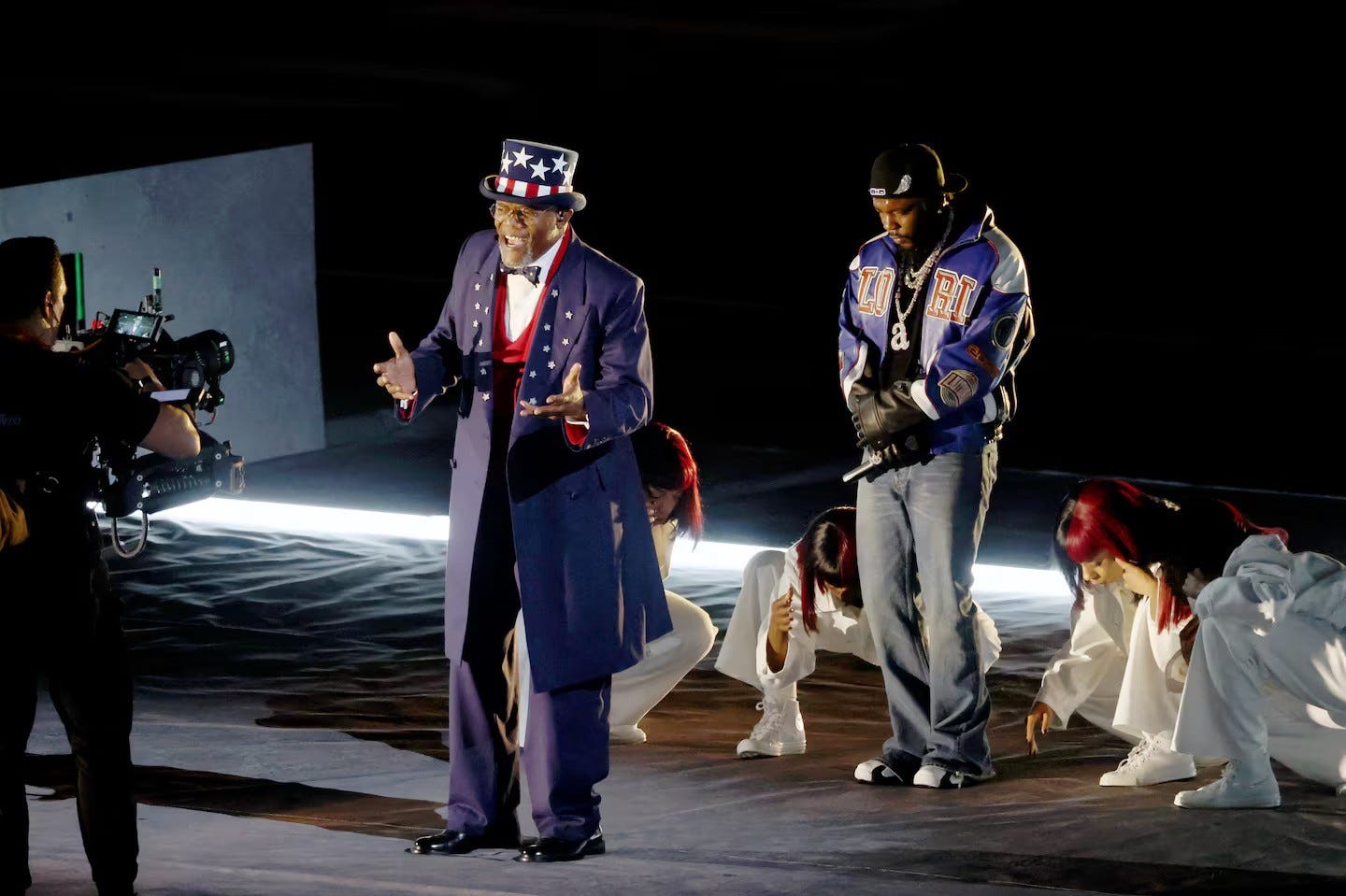
Samuel L. Jackson and “The Great American Game”
“Welcome to the great American game.”
At first glance, this line seemed like a nod to football itself. But this wasn’t about sports. This was about the real American game—the game of power, race, and survival.
Jackson’s portrayal of Uncle Sam wasn’t the stern, authoritative figure from military recruitment posters. Instead, he was an almost cynical announcer, presiding over a system designed to keep Black Americans playing a game they weren’t meant to win. His tone was both sarcastic and ominous, immediately shifting the focus from the expected pomp of the Super Bowl to something far more consequential.
The choice of Jackson for this role was intentional. As an actor, Jackson has long been associated with roles that challenge authority, expose systemic injustice, and demand reckoning. His commanding presence added an air of undeniable gravitas to the moment, forcing the audience to confront the subtext of the performance rather than simply consuming it as entertainment.
By referring to America as a “game,” Jackson was pointing to the manufactured rules of racial and economic oppression, highlighting how Black people are expected to navigate a system that was never designed for them to succeed. His Uncle Sam was not inviting participation—he was exposing the rigged nature of the game itself.
Then came the most cutting moment of Jackson’s introduction. Looking directly at Lamar, he taunted him with the words:
“No, no, no, no, no. Too loud. Too reckless. Too ghetto. Mr. Lamar, do you really know how to play the game? Then tighten up.”
These words were laced with history—the same criticisms that have been hurled at Black athletes, artists, and activists for generations. Black success has often been policed, scrutinized, and labeled “too much” for mainstream comfort. Lamar standing on that stage, receiving these words from an embodiment of American authority, was a stark reflection of how Black voices are continually silenced and told to conform.
Jackson’s Uncle Sam was the voice of systemic power, echoing the sentiments that have long been used to suppress Black autonomy: You’re too much. You don’t belong. Play by our rules, or you won’t play at all.
Then, the tic-tac-toe board lit up beneath Lamar’s feet—a visual metaphor for a game rigged against Black people from the start. The statement wasn’t just a challenge to Lamar—it was a callout of America’s hypocrisy, a reminder that no matter how talented, strategic, or disciplined Black Americans are, the system still finds ways to tell them they are “too much.”
Jackson’s presence and delivery heightened the weight of what was about to unfold. He wasn’t simply introducing a performance—he was setting the stage for a confrontation. His Uncle Sam figure loomed over the performance like a reminder of history’s failures, forcing America to look at itself in the mirror before Lamar even delivered his first verse.
By the time the music started, the audience had already been given a stark warning: This was not going to be a halftime show like any other.
The Tic-Tac-Toe Board and Squid Game Symbolism: The Illusion of Choice
One of the most visually compelling elements of Lamar’s performance was the massive tic-tac-toe board beneath his feet, but this wasn’t just a random design choice. The board, combined with Squid Game-inspired symbols and the hoodies worn by the dancers, suggested something much deeper: the illusion of choice and systemic entrapment.
In Squid Game, participants are placed in rigged competitions where survival depends on forces beyond their control—an allegory for capitalism, debt, and class struggles. Similarly, tic-tac-toe is a game that, when played optimally, almost always ends in a draw—a reflection of how Black Americans, no matter how strategically they move, are still trapped in a system that refuses to let them win.
The dancers in red hoodies mimicked the aesthetic of the Squid Game enforcers, reinforcing the idea that the players—Black Americans in this case—are controlled by invisible forces that dictate their fate. The triangle, square, and circle symbols embedded in the stage and mirrored in the choreography echoed the hierarchy present in Squid Game, where power is exerted over the players, determining who survives and who doesn’t.
Lamar standing at the center of this game, refusing to conform, rejecting the premise, and ultimately breaking the cycle through performance, was a symbolic rejection of the systems designed to keep Black individuals in a perpetual game of survival rather than liberation.
This staging choice tied into the broader themes of his performance—resistance, defiance, and the exposure of a rigged system masquerading as fair play. It was a reminder that even in a game where the outcome seems predetermined, breaking the rules is the only way to truly win.
“40 Acres and a Mule” and the Legacy of Broken Promises
One of the most powerful lyrical moments came when Lamar invoked:
“40 acres and a mule, this is bigger than the music.”
For those unfamiliar, “40 acres and a mule” was a promise made in 1865 to newly freed Black Americans—a promise that was swiftly revoked, reinforcing centuries of economic oppression. Lamar’s use of this phrase wasn’t just a historical reference; it was a reminder of how Black communities have been repeatedly denied what they are owed while still being expected to uphold the nation that betrayed them.
By adding “this is bigger than the music,” Lamar made sure the audience understood that this was not just a lyrical flourish—it was a declaration that the fight for justice extends beyond entertainment and into the real world. He was using his platform to remind America that the economic oppression of Black people is an ongoing reality, not a closed chapter in history.
Delivered on a tic-tac-toe board, the phrase became even more pointed: This was a rigged game, one where reparations never came, and systemic barriers ensured that economic justice remained just out of reach. The symbolism of Lamar standing atop a board designed for unwinnable outcomes reinforced the idea that Black Americans have long been set up to fail—yet Lamar’s commanding presence on that stage defied the very premise of that system.
The Presence of Trump in the Audience: The Unspoken Confrontation
What made this performance even more significant was who was watching.
Donald Trump, a man who has spent years attacking Black protest in sports, was in the audience, forced to sit through a halftime show that directly countered everything he stood for.
For context, Trump had:
Condemned NFL players like Colin Kaepernick for kneeling in protest against racial injustice.
Called Black activists “thugs” while emboldening white nationalist rhetoric.
Used sports as a political battlefield, demanding that Black athletes stay in their place.
And now, here was Kendrick Lamar, standing center stage, performing a show filled with Black resistance, historical reckoning, and raw truth—right in Trump’s face.
The significance of Kendrick Lamar’s performance is even more profound now, given the current political climate and Donald Trump’s ongoing rollback of diversity, equity, and inclusion (DEI) initiatives. In his second presidency, Trump has aggressively targeted DEI policies, dismantling efforts to promote racial equity across federal agencies, education, and the corporate world.
As reported by AP News, “In January 2025, President Trump signed executive orders aimed at terminating DEI programs within the federal government, advocating for a return to merit-based employment and promotions.” These orders have led to the removal of DEI mandates at the federal level, fueling a broader conservative movement against racial and gender-conscious policies. (AP News)
In this context, Lamar’s performance serves as an even more powerful act of resistance. While Trump actively works to erase DEI initiatives and suppress conversations about systemic racism, Lamar’s presence on that stage reaffirmed their necessity. His performance was not just a showcase of artistry but a direct counter to the administration’s attempts to erase Black history, struggle, and triumph.
As The Guardian noted in a recent analysis, “We are witnessing the rise of a new Republican ‘Southern Strategy,’ one that seeks to dismantle hard-fought gains in racial justice by attacking DEI as a proxy for broader civil rights rollbacks.” (The Guardian)
Lamar never said Trump’s name. He didn’t have to. His performance stood in defiant contrast to the policies and rhetoric of an administration trying to rewrite history and suppress the progress of marginalized communities. His art, more than ever, is a form of protest against those who seek to silence voices like his.
The Online Backlash: Why It Matters
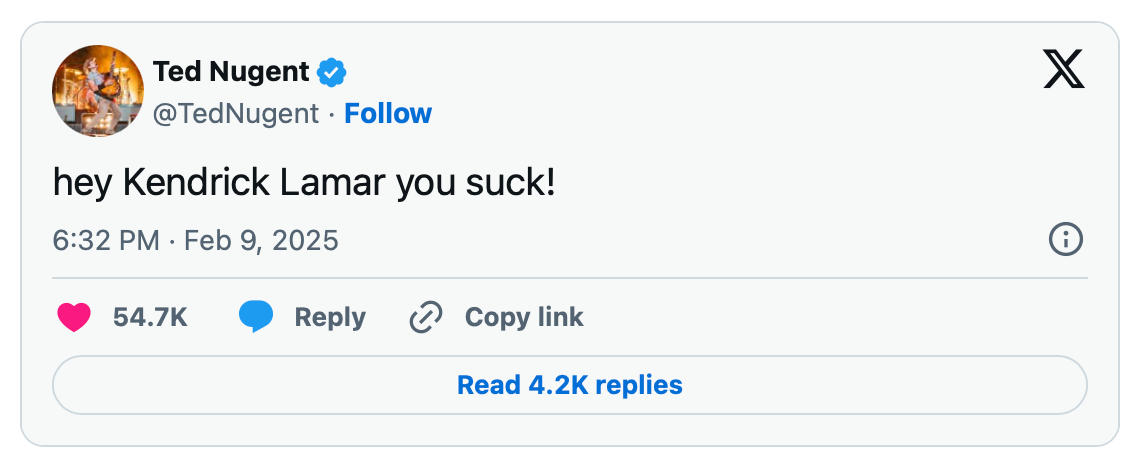
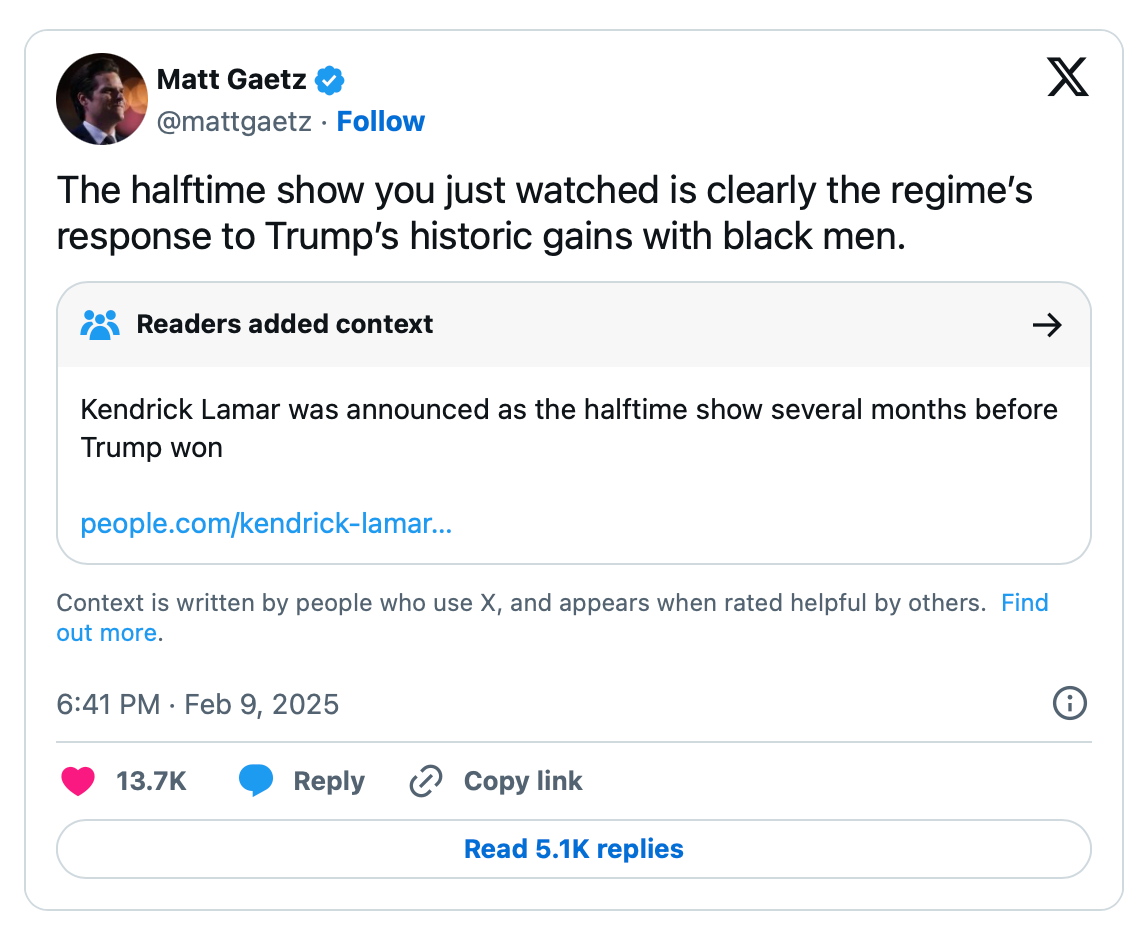
Despite the brilliance of Lamar’s halftime show, the online backlash was immediate. Critics accused the performance of being “too political,” “too divisive,” and even “too Black.” The fact that a performance celebrating Black identity and resistance was met with outrage underscores exactly why it was necessary in the first place.
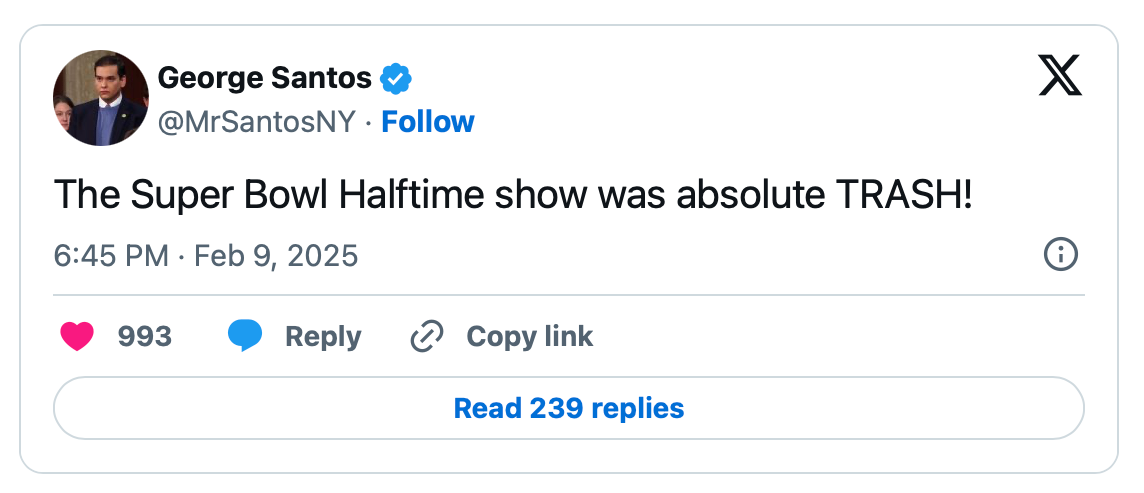
This reaction reveals the ongoing discomfort with Black autonomy in mainstream spaces. Historically, Black artists have been expected to share or dilute their narratives to make them more palatable to white audiences. The outrage over the absence of white performers only reinforced the expectation that Black success must always include white validation.
Lamar’s performance challenged this norm head-on, presenting Black resistance on its own terms, without apology. The backlash is important because it demonstrates just how deeply ingrained these expectations are—and why breaking them is such a radical act.
HUMBLE: A Defiant Act of Reversal
One of the standout moments of Lamar’s setlist was his performance of HUMBLE., a track often misinterpreted as a call for personal modesty. However, in the context of this halftime show, HUMBLE. took on a completely different meaning.
The phrase “Sit down, be humble” has long been weaponized against Black individuals, particularly those who assert themselves in spaces historically dominated by whiteness. The demand for Black athletes, artists, and activists to be “grateful” for their success is a recurring theme in American culture. Yet, Lamar’s performance flipped that expectation on its head.
Standing on a stage that symbolized systemic oppression, Lamar delivered the song with unshakable confidence, emphasizing that Black excellence does not have to come with submission. His presence and performance made it clear: This was not a request for humility but a demand for recognition.
Rather than reinforcing the idea that Black success must come with quiet gratitude, Lamar’s HUMBLE. became an assertion of self-worth, power, and defiance against those who attempt to minimize Black achievement.
Final Thoughts: The Revolution Was Televised
Kendrick Lamar didn’t just perform at the Super Bowl. He disrupted it.
This performance wasn’t about pandering to mass audiences, delivering a palatable and safe display of Black culture that fits neatly within the confines of mainstream entertainment. Instead, Lamar used this platform as a megaphone to confront America with its own contradictions. He transformed a corporate spectacle designed for consumer enjoyment into a profound act of rebellion—forcing viewers to sit with uncomfortable truths.
The revolution was televised, but it wasn’t an invitation to observe passively. It was a demand for recognition, an assertion of Black power, and an indictment of the very structures that continue to oppress. The symbols, the words, and the stage design were intentional: this was Lamar seizing a space that has historically excluded or tokenized Black voices and reshaping it on his own terms.
This halftime show will be remembered not just for its artistry, but for its fearlessness. The backlash it received proves how necessary it was. The outrage over its Blackness, its political weight, and its resistance to conformity only underscores why performances like this are critical—because they expose the very discomfort that America has with Black autonomy.
Lamar didn’t just put on a show. He issued a challenge. A challenge to the NFL, to the industry, and to every viewer watching at home: Are you listening? Do you see us? Are you finally ready to acknowledge the weight of our history and the power of our voices?
This performance was a declaration that Black artistry does not have to seek approval. It does not have to fit into neat, marketable boxes. It can be loud. It can be confrontational. It can be unapologetically itself.
And that is why Kendrick Lamar won this game—by refusing to play it at all.
For artists who fear speaking truth to power, this performance should serve as a lesson in courage, artistic integrity, and the undeniable ability of art to challenge systems of oppression. No matter how large the stage or how mainstream the platform, it can always be done. Art is not just entertainment—it is resistance, it is history, and when wielded with intention, it is revolution.

Denise “The Vamp DeVille” Zubizarreta is a neurodivergent mixed media interdisciplinary artist and cultural operations strategist for arts organizations. She is also a scholar and researcher focusing on applied social justice and its impact on the arts and artists. Of Puerto Rican and Cuban descent, her research and artwork explore the impact of colonialism in the Caribbean. Denise brings over two decades of experience in diverse creative fields. Currently, she serves as an arts and culture writer for leading publications that offer curated and critical perspectives on contemporary arts and culture.
Zubizarreta holds a B.F.A. in Fine Art from the Rocky Mountain College of Art + Design (RMCAD) and is completing her Masters in Arts Leadership and Cultural Management (M.A.L.C.M.) at Colorado State University. Her passion for arts and culture drives her to explore and challenge the intersections of post-colonial theory, identity, technology, and traditions in her writing and mixed media works.